
AEGLE MEDICAL
PEPTIDE THERAPIES
PEPTIDE THERAPIES
Peptide therapy sits at an unusual intersection: genuinely promising research on one side, and a marketplace flooded with unregulated, unproven, and sometimes unsafe products on the other. Many peptides available today have not been evaluated by the FDA for safety or efficacy, and “available” does not mean “appropriate” – for you, or for anyone. At AEGLE, we apply the same standard to peptides that we apply to every tool in our club: we evaluate the evidence, not the headline.
Below, we’ve outlined the specific peptides we offer, the clinical reasoning behind each one, and, just as importantly, the peptides we’ve chosen not to offer and why. Our goal isn’t to give you access to everything on the market. It’s to give you honest, science-backed guidance on what’s actually worth considering, and what isn’t.
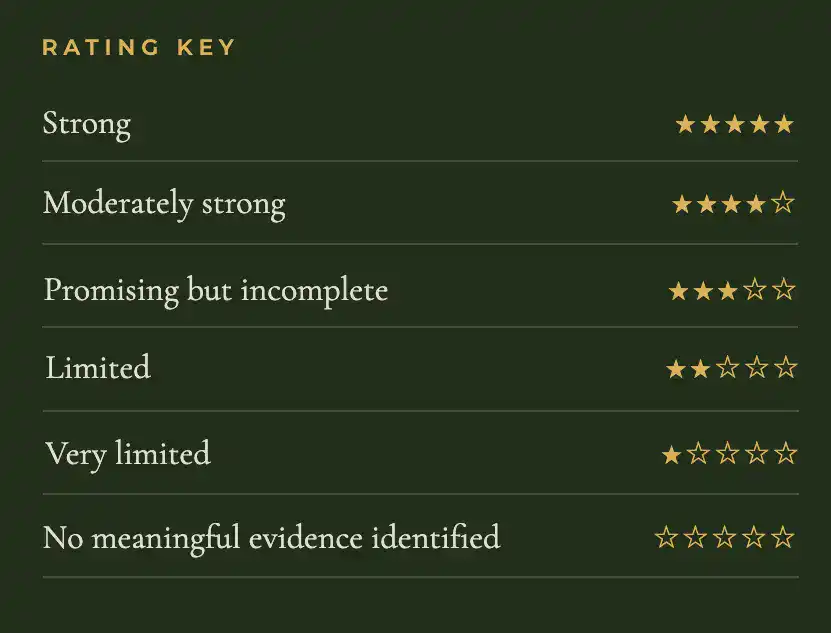
The “AEGLE recommendation” is a clinical and strategic judgement, not a mathematical average.
Peptides & Therapies Currently Offered
Prescribed within an FDA-approved indication, or a clearly defined and supervised program
COMMONLY PROMOTED FOR
Type 2 diabetes management, chronic weight management, and cardiovascular risk reduction in adults with established heart disease and overweight or obesity. At AEGLE, we prescribe it specifically for weight loss and metabolic management.
Human Evidence
★★★★★
Supported by some of the largest and most rigorous randomized trial programs in current use, including the STEP program for weight loss, the SELECT trial (roughly 17,600 patients) for cardiovascular risk reduction, the FLOW trial for kidney disease, and emerging trial data for liver disease (MASH).
Biological Plausibility
★★★★★
GLP-1 receptor agonism is a well-established incretin pathway with broad, mechanistically consistent effects on appetite, glucose regulation and cardiometabolic risk.
Safety Evidence
★★★★☆
Gastrointestinal effects (nausea, vomiting, diarrhea) are common and well characterized; pancreatitis and gallbladder disease are recognized risks; carries a boxed warning for thyroid C-cell tumor risk based on rodent data. An emerging signal for a rare eye condition (NAION) is under review and has not yet resulted in a formal FDA safety communication.
Product & Regulatory Confidence
★★★★★ FDA-approved branded product
★★★☆☆ via our approved 503B compounding pharmacy
The national shortage that broadly permitted compounding has been resolved, and FDA has proposed removing semaglutide from the 503B bulks list altogether. We treat compounded supply as a narrower, evolving pathway reserved for legitimate clinical need, sourced exclusively through our vetted, FDA-registered 503B compounding partner, not through unregistered vendors, which FDA has linked to adverse events, counterfeiting and fraudulent labeling.
Clinical Usefulness
★★★★★
Well-established dosing, titration protocols and patient-selection criteria across its approved indications.
OVERALL CONFIDENCE
High for its FDA-approved indications, whether sourced through licensed pharmacy or our approved 503B compounding partner.
AEGLE Recommendation
We offer semaglutide (Ozempic, Wegovy, Rybelsus) for chronic weight management and metabolic health, available either as the FDA-approved branded product or through our approved 503B compounding pharmacy, sourced exclusively through licensed and FDA-registered channels. AEGLE is a wellness club, not a primary care practice, so we prescribe semaglutide for weight and metabolic goals rather than for type 2 diabetes management. Patients who need semaglutide primarily to manage diabetes are referred to their primary care physician or endocrinologist, who can provide the ongoing glucose monitoring and diabetes-specific care that condition deserves, and we’re glad to coordinate with that provider.
What Would Change Our Position
We continue to monitor the emerging NAION (vision-related) safety signal now under FDA review, along with the FDA’s proposed rule that would remove semaglutide from the 503B compounding bulks list- if finalized, that would end our compounding pathway and we would move fully to the branded product. We’ll update our protocols as the agency issues new guidance.
COMMONLY PROMOTED FOR
Type 2 diabetes management, chronic weight management, and obstructive sleep apnea in adults with obesity. At AEGLE, we prescribe it specifically for weight loss, metabolic management and sleep apnea related to obesity.
Human Evidence
★★★★★
SURPASS trials show HbA1c reductions of roughly 1.5 to 2.4 percentage points, and SURMOUNT trials show weight loss up to roughly 26% in some cohorts, generally exceeding semaglutide’s effect size head-to-head; SURMOUNT-OSA supports its use for obstructive sleep apnea.
Biological Plausibility
★★★★★
Dual GIP/GLP-1 receptor agonism, an extension of the same incretin biology underlying semaglutide with an additional receptor target.
Safety Evidence
★★★★☆
Similar gastrointestinal, pancreatitis and gallbladder profile to other GLP-1 therapies, with the same class boxed warning for thyroid C-cell tumor risk based on rodent data; no confirmed human thyroid cancer signal to date.
Product & Regulatory Confidence
★★★★★ FDA-approved branded product
★★★☆☆ via our approved 503B compounding pharmacy
he shortage that justified broad compounding resolved in December 2024, and FDA has proposed removing tirzepatide from the 503B bulks list altogether. We treat compounded supply as a narrower, evolving pathway reserved for legitimate clinical need, sourced exclusively through our vetted, FDA-registered 503B compounding partner — not through unregistered vendors, which FDA has linked to dosing errors and quality concerns.
Clinical Usefulness
★★★★★
Established dosing and titration protocols across the broadest indication set of the GLP-1/GIP therapies reviewed here.
OVERALL CONFIDENCE
High for its FDA-approved indications, whether sourced through licensed pharmacy or our approved 503B compounding partner.
AEGLE Recommendation
We offer tirzepatide (Mounjaro, Zepbound) for chronic weight management, metabolic health, and obstructive sleep apnea in patients with obesity, available either as the FDA-approved branded product or through our approved 503B compounding pharmacy, sourced exclusively through licensed and FDA-registered channels. AEGLE is a wellness club, not a primary care practice, so we prescribe tirzepatide for weight, metabolic and sleep-apnea goals rather than for type 2 diabetes management. Patients who need tirzepatide primarily to manage diabetes are referred to their primary care physician or endocrinologist, who can provide the ongoing glucose monitoring and diabetes-specific care that condition deserves, and we’re glad to coordinate with that provider.
What Would Change Our Position
Further FDA action on its proposed removal of tirzepatide from the 503B compounding bulks list – if finalized, that would end our compounding pathway and we would move fully to the branded product – and continued surveillance for thyroid or other emerging safety signals across the drug class.
Visceral fat reduction, body composition and “belly fat.”
Human Evidence
★★★★★ for its approved population
Randomized clinical evidence supports reduction of excess abdominal fat in adults with HIV-associated lipodystrophy.
Biological Plausibility
★★★★★
Tesamorelin is a growth-hormone-releasing factor analogue that raises growth hormone and insulin-like growth factor 1 activity.
Safety Evidence
★★★★☆ within the approved population
Risks include glucose effects, fluid retention, injection reactions and concerns related to elevated insulin-like growth factor 1.
Product & Regulatory Confidence
★★★★★ FDA-approved branded product
FDA-approved for a narrow indication.
Clinical Usefulness
★★★★★ for HIV-lipodystrophy
★☆☆☆☆ for cosmetic fat loss
The approved indication should not be converted into a general longevity or weight-loss claim.
OVERALL CONFIDENCE
High within the approved indication; low for wellness use.
AEGLE Recommendation
We prescribe tesamorelin only when medically indicated, most notably for HIV-associated lipodystrophy, where randomized trials support meaningful reduction in excess abdominal fat. We do not offer it as a general visceral-fat reduction or anti-aging treatment, since that use falls outside its FDA-approved, evidence-backed indication.
What Would Change Our Position
Controlled trial evidence establishing meaningful, safe benefit for visceral-fat reduction or anti-aging in the general wellness population, outside the currently approved indication.
COMMONLY PROMOTED FOR
Skin texture, fine lines, collagen support, wound repair, scalp health and hair appearance.
Human Evidence
★★★☆☆
There are controlled and observational skin data, but the studies are relatively small and not uniformly positive.
Biological Plausibility
★★★★★
GHK-Cu influences fibroblast activity, collagen and elastin biology, extracellular matrix remodeling and wound-repair pathways.
Safety Evidence
★★★☆☆
Topical use has a more reassuring practical history than injection, although irritation, formulation stability and product quality remain relevant.
Product & Regulatory Confidence
★★★☆☆
Noninjectable GHK-Cu is currently under FDA evaluation for potential use in compounding. Cosmetic products containing copper tripeptide-1 also exist, but cosmetic status does not prove clinical effectiveness.
Clinical Usefulness
★★★★☆
Skin appearance can be assessed with standardized photography, skin analysis and symptom tracking.
OVERALL CONFIDENCE
Moderate for topical cosmetic use; low for disease claims.
AEGLE Recommendation
We do offer topical GHK-Cu as part of our skin-health program. The evidence for skin texture, collagen support and wound repair is encouraging, though studies remain relatively small and not uniformly positive, so we position it as a supportive part of a broader skincare plan rather than an anti-aging cure, and we track your results with standardized photography and skin analysis along the way.
What Would Change Our Position
Larger independent cosmetic trials and better comparative data against established retinoid and skin-rejuvenation regimens.
COMMONLY PROMOTED FOR
FDA-approved treatment of hypoactive sexual desire disorder (HSDD) in premenopausal women; also promoted off-label for general libido enhancement, tanning and weight loss.
Human Evidence
★★★☆☆ for its approved indication
Two Phase 3 randomized controlled trials support a modest but statistically significant improvement in desire and related distress in premenopausal women with HSDD. Off-label uses such as general libido enhancement, tanning or weight loss have no controlled human trial support in Vyleesi’s own research and largely trace back to unrelated Melanotan-II studies.
Biological Plausibility
★★★★☆
Bremelanotide is a melanocortin receptor agonist acting primarily through MC4R, a pathway with a credible role in central sexual-desire signaling; activity at MC1R plausibly explains its pigmentation effects.
Safety Evidence
★★☆☆☆
Nausea affects roughly 40% of patients in trials, with transient increases in blood pressure and decreases in heart rate after each dose, and focal hyperpigmentation in about 1% of patients. It is contraindicated in uncontrolled hypertension and known cardiovascular disease.
Product & Regulatory Confidence
★★★★☆ FDA-approved branded product
FDA-approved as Vyleesi for a narrow indication. Unregulated “PT-141” research-grade vials sold outside licensed pharmacy channels are a separate, much less reliable product category.
Clinical Usefulness
★★★☆☆ for HSDD
★☆☆☆☆ for off-label use
Useful within its approved population with routine cardiovascular screening and blood-pressure monitoring; the approved indication should not be extended into a general libido, tanning or weight-loss offering.
OVERALL CONFIDENCE
Moderate within its approved indication; very low for off-label promotion.
AEGLE Recommendation
We prescribe bremelanotide (Vyleesi) only for its FDA-approved indication, hypoactive sexual desire disorder in premenopausal women, sourced through licensed pharmacies and paired with cardiovascular screening and blood-pressure monitoring. We do not offer it, or unregulated “PT-141” research vials, for general libido enhancement, tanning or weight loss – those uses aren’t supported by Vyleesi’s own clinical trials and largely trace back to unrelated, unapproved Melanotan-II research.
What Would Change Our Position
Controlled trial evidence supporting additional populations or indications, a corresponding FDA label expansion, and a legitimate pharmacy pathway for any expanded use.
Peptides NOT Currently Offered
On the active evidence and regulatory watchlist
Tendon, ligament, muscle and gastrointestinal healing; pain reduction; injury recovery.
Human Evidence
★☆☆☆☆
Most positive evidence comes from animal studies. Published human experience is extremely small and does not include robust randomized controlled trials demonstrating musculoskeletal healing.
Biological Plausibility
★★★★☆
Preclinical research suggests effects involving angiogenesis, fibroblasts, collagen organization, nitric oxide pathways and tissue repair.
Safety Evidence
★☆☆☆☆
Long-term human safety, immunogenicity, cancer-related implications, dose-response relationships and route-specific risks are not adequately characterized.
Product & Regulatory Confidence
★☆☆☆☆
Not FDA-approved. Federal compounding status remains unsettled, and an FDA advisory vote does not itself establish approval or a permanent legal pathway.
Clinical Usefulness
★★☆☆☆
Potentially relevant to difficult injuries, but patient selection, dose, route, endpoint and comparative effectiveness remain uncertain.
OVERALL CONFIDENCE
Low.
AEGLE Recommendation
We are not currently offering BPC-157. The strongest evidence for tendon, ligament and gastrointestinal healing comes from animal studies, and it hasn’t yet been confirmed in well-designed human trials. We’re watching the research and regulatory landscape closely, and in the meantime our team is happy to walk you through what’s known and connect you with established diagnosis, rehabilitation and sports medicine care.
What Would Change Our Position
A defensible compounding pathway, independent product-quality verification, replicated controlled human trials and meaningful safety follow-up.
On Patient-Requested, “I’ll Accept the Risk” Use
We understand some patients ask to receive BPC-157 on the basis that they personally accept the risk. A signed waiver or verbal assumption of risk does not give a provider legal authority to administer it. BPC-157 has no FDA-approved indication, so its use is not governed by the same off-label framework that applies to approved drugs — it is the administration of an unapproved product, and it has not yet been placed on the FDA’s approved list of legally compoundable substances. Patient consent does not remove provider liability, malpractice exposure, or medical board risk. For these reasons, AEGLE does not offer BPC-157 on an assumption-of-risk basis; this summary is general information, not legal advice, and any change in our position would require review by regulatory and healthcare counsel.
COMMONLY PROMOTED FOR
Weight loss, obesity treatment and metabolic health, as an investigational “triple agonist” combining GIP, GLP-1 and glucagon receptor activity.
Human Evidence
★★★★☆
The Phase 3 TRIUMPH-1 trial reported mean weight loss up to roughly 28–30%, the largest reported for any anti-obesity drug to date. That said, the drug has not completed FDA review, and long-term outcomes data comparable to existing cardiovascular or kidney-outcome trials for approved GLP-1 therapies do not yet exist.
Biological Plausibility
★★★★★
Triple agonism at GIP, GLP-1 and glucagon receptors, an extension of the same incretin biology underlying tirzepatide with an additional receptor target.
Safety Evidence
★★★★☆
Gastrointestinal effects are consistent with the broader drug class. Trials have also shown a distinct dose-dependent increase in resting heart rate, tied to combined GLP-1/glucagon signaling — a safety consideration not seen with dual agonists. The drug is expected to carry the same class boxed warning for thyroid C-cell tumor risk, but postmarket, real-world safety experience does not yet exist.
Product & Regulatory Confidence
★☆☆☆☆
Not FDA-approved. Still in Phase 3 development, with a formal application not expected until late 2026 or 2027 and approval unlikely before 2028. It is not a legal compounding candidate, since it is not a component of any approved drug — the FDA has issued warning letters to more than 50 compounders and vendors selling retatrutide-labeled “research chemicals.”
Clinical Usefulness
☆☆☆☆☆
No approved dosing, prescribing information or patient-selection framework exists yet; it is currently available only through clinical trial enrollment.
OVERALL CONFIDENCE
Low today from a regulatory standpoint, despite some of the most promising Phase 3 efficacy data reported for a weight-loss therapy so far.
AEGLE Recommendation
We do not currently offer retatrutide. It remains investigational — not yet FDA-approved, with no legal compounding pathway — even though its Phase 3 trial results are among the most impressive weight-loss data reported to date. We do not source it through the “research chemical” vendors currently being targeted by FDA warning letters, and we will not offer it until it has full FDA approval and a legitimate pharmacy supply chain.
What Would Change Our Position
FDA approval following completion of the TRIUMPH Phase 3 program, and access through licensed pharmacies rather than compounded or gray-market channels.
On Gray-Market, “Research Chemical” Requests
Given retatrutide’s headline trial results, we understand patients may ask about sourcing it before approval. Because it is not a component of any approved drug, it cannot legally be compounded today, and the FDA has issued warning letters to more than 50 vendors selling retatrutide-labeled products for this reason. Impressive Phase 3 data does not substitute for FDA review or a legal, quality-assured supply chain, and we do not offer or source gray-market retatrutide on that basis.
COMMONLY PROMOTED FOR
Soft-tissue repair, wound healing, flexibility, recovery and reduced inflammation.
Human Evidence
☆☆☆☆☆
Human orthopaedic evidence for TB-500 is essentially absent. It is often marketed by extrapolating from research on naturally occurring thymosin beta-4, although marketed TB-500 products may not be equivalent to the full endogenous peptide.
Biological Plausibility
★★★★☆
Thymosin beta-4 has credible roles in cell migration, angiogenesis and tissue repair.
Safety Evidence
★☆☆☆☆
Systemic and long-term safety of marketed TB-500 protocols is not adequately established.
Product & Regulatory Confidence
★☆☆☆☆
Not FDA-approved for injury recovery. Compounding status and product identity require substantial caution.
Clinical Usefulness
★☆☆☆☆
No established protocol or well-defined human treatment population.
OVERALL CONFIDENCE
Very low.
AEGLE Recommendation
We are not currently offering TB-500. Human evidence for tendon, ligament or soft-tissue healing is essentially absent, and it’s often marketed by drawing on research for a related but distinct naturally occurring protein. The systemic safety of marketed TB-500 products also hasn’t been adequately studied.
What Would Change Our Position
Controlled human trials using a clearly characterized product and an established lawful sourcing pathway.
COMMONLY PROMOTED FOR
Systemic regeneration, skin rejuvenation, hair growth, wound healing and anti-aging.
Human Evidence
★☆☆☆☆
Topical and laboratory findings cannot be assumed to establish systemic injectable effectiveness.
Biological Plausibility
★★★★☆
The molecule has broad regenerative signaling effects, but systemic biological activity also raises unanswered safety questions.
Safety Evidence
★☆☆☆☆
Adequate injectable dosing, pharmacokinetic and long-term safety studies are lacking.
Product & Regulatory Confidence
★☆☆☆☆
The current FDA category under evaluation specifically excludes injectable routes.
Clinical Usefulness
★☆☆☆☆
No established systemic indication or validated injectable protocol.
OVERALL CONFIDENCE
Very Low.
AEGLE Recommendation
We do not offer injectable GHK-Cu. Its topical and laboratory findings can’t be assumed to carry over to systemic, injectable use, and the injectable route currently falls outside the FDA category being evaluated for compounding, with dosing, pharmacokinetic and long-term safety data still lacking.
What Would Change Our Position
Controlled human trials establishing safe injectable dosing and pharmacokinetics, meaningful long-term safety data, and a clear regulatory pathway for the injectable route.
COMMONLY PROMOTED FOR
Inflammation, inflammatory bowel disease, skin inflammation and wound healing.
Human Evidence
☆☆☆☆☆
FDA reviewers reported that they had not identified human exposure data for drug products containing KPV by any route.
Biological Plausibility
★★★☆☆
KPV is related to alpha-melanocyte-stimulating hormone biology and has anti-inflammatory activity in experimental models.
Safety Evidence
☆☆☆☆☆
Human safety is not adequately characterized.
Product & Regulatory Confidence
★☆☆☆☆
Not FDA-approved. It was reviewed for possible 503A listing, but the FDA proposed against inclusion.
Clinical Usefulness
★☆☆☆☆
No validated patient-selection or dosing framework.
OVERALL CONFIDENCE
Very Low
AEGLE Recommendation
We do not currently offer KPV outside of a legitimate clinical study. FDA reviewers have reported that no human exposure data exists for KPV products by any route, so its human safety hasn’t yet been characterized well enough for us to recommend it.
What Would Change Our Position
Documented human safety and exposure data, along with a clearer, more favorable regulatory pathway.
COMMONLY PROMOTED FOR
Fat loss, insulin sensitivity, exercise capacity, mitochondrial health, longevity and osteoporosis prevention.
Human Evidence
★☆☆☆☆
Human observational research on endogenous MOTS-c biology should not be confused with trials establishing benefits from administering synthetic MOTS-c.
Biological Plausibility
★★★★☆
MOTS-c is a mitochondria-derived peptide involved in metabolic signaling and stress responses.
Safety Evidence
☆☆☆☆☆
FDA reviewers reported no identified human exposure data for administered MOTS-c drug products and raised concerns involving immunogenicity and peptide-related impurities.
Product & Regulatory Confidence
★☆☆☆☆
Not FDA-approved, with unresolved compounding status.
Clinical Usefulness
★☆☆☆☆
No validated longevity, obesity or osteoporosis treatment protocol.
OVERALL CONFIDENCE
Very low for treatment, despite interesting biology.
AEGLE Recommendation
We are not currently offering MOTS-c. While the underlying biology is genuinely interesting, there is no human exposure data for administered synthetic MOTS-c, and questions about immunogenicity and product purity remain unresolved. We’re continuing to follow this research closely.
What Would Change Our Position
Established human safety and exposure data, resolution of immunogenicity and impurity concerns, and validated protocols for its promoted uses.
COMMONLY PROMOTED FOR
Fat loss without the adverse effects attributed to full growth hormone treatment.
Human Evidence
★★☆☆☆
It underwent obesity-related clinical development, but it did not become an established effective obesity medication.
Biological Plausibility
★★★☆☆
It is a modified fragment related to the fat-metabolism portion of growth hormone biology.
Safety Evidence
★★☆☆☆
Some human exposure exists, but safety and effectiveness for contemporary compounded regimens are not sufficiently established.
Product & Regulatory Confidence
★☆☆☆☆
Not FDA-approved for weight management.
Clinical Usefulness
★☆☆☆☆
There are substantially better-supported obesity treatments.
OVERALL CONFIDENCE
Low.
AEGLE Recommendation
We do not offer AOD-9604 for weight management. It went through obesity-related clinical development but did not become an established, effective obesity treatment, and there are substantially better-supported options we can offer instead.
What Would Change Our Position
New controlled trials demonstrating meaningful, reproducible fat-loss benefit compared with established obesity treatments.
COMMONLY PROMOTED FOR
Increased growth hormone, muscle gain, fat loss, sleep, recovery and anti-aging.
Human Evidence
★★☆☆☆
Small human studies demonstrate sustained increases in growth hormone and insulin-like growth factor 1. They do not establish meaningful long-term wellness, body-composition or anti-aging outcomes.
Biological Plausibility
★★★★☆
It is a long-acting growth-hormone-releasing hormone analogue.
Safety Evidence
★★☆☆☆
Long-term risks of sustained growth hormone and insulin-like growth factor 1 stimulation in wellness populations are inadequately studied.
Product & Regulatory Confidence
★☆☆☆☆
Not FDA-approved for anti-aging or body-composition enhancement.
Clinical Usefulness
★☆☆☆☆
Hormonal changes are measurable, but clinically important benefit has not been established.
OVERALL CONFIDENCE
Low.
AEGLE Recommendation
We do not currently offer CJC-1295. Small studies show it raises growth hormone and insulin-like growth factor 1 levels, but this hasn’t been shown to translate into meaningful, lasting improvements in body composition, sleep or anti-aging, and the long-term safety of sustained hormone stimulation in healthy adults isn’t well studied.
What Would Change Our Position
Controlled trials demonstrating meaningful wellness outcomes alongside adequate long-term safety data for sustained growth hormone and insulin-like growth factor 1 stimulation in healthy adults.
COMMONLY PROMOTED FOR
Growth hormone support, muscle gain, fat loss, recovery, sleep and anti-aging.
Human Evidence
★☆☆☆☆
Much of the evidence involves pharmacology or early development rather than demonstrated clinical outcomes in wellness patients.
Biological Plausibility
★★★★☆
Ipamorelin is a growth hormone secretagogue with relative receptor selectivity.
Safety Evidence
★☆☆☆☆
Long-term metabolic, neoplastic and endocrine safety in healthy adults is not established.
Product & Regulatory Confidence
★☆☆☆☆
Not FDA-approved for routine wellness, body composition or anti-aging use.
Clinical Usefulness
★☆☆☆☆
No well-established wellness indication.
OVERALL CONFIDENCE
Very Low.
AEGLE Recommendation
We do not currently offer ipamorelin, either alone or as part of a CJC-1295 stack. Much of the existing research is early-stage pharmacology rather than demonstrated outcomes in wellness patients, and its long-term safety in healthy adults has not been established.
What Would Change Our Position
Controlled trials establishing meaningful wellness benefit, along with long-term metabolic, endocrine and safety data in healthy adult populations.
COMMONLY PROMOTED FOR
Anxiety reduction, stress resilience, mood support and mild immune modulation.
Human Evidence
★☆☆☆☆
Supporting trials are Russian-language, relatively small, and often compare Selank against an active medication rather than placebo. There is no independent replication in Western peer-reviewed literature.
Biological Plausibility
★★★☆☆
Selank is a synthetic tuftsin analogue. Proposed mechanisms include inhibition of enkephalin-degrading enzymes and modest effects on GABAergic, monoamine and HPA-axis activity, though this story is less developed and less replicated than Semax’s.
Safety Evidence
★☆☆☆☆
Short trials report mild nasal irritation and occasional headache with no serious adverse events, but there is no safety data beyond roughly 30 days of use and none in pregnancy, lactation or pediatric populations.
Product & Regulatory Confidence
★☆☆☆☆
Not FDA-approved. Its nomination for the FDA’s 503A compounding bulk-substance list was withdrawn in 2024, and unlike several related peptides, it was not part of the FDA’s July 2026 compounding advisory committee review — leaving its regulatory pathway comparatively stalled. It is widely sold labeled “research use only.”
Clinical Usefulness
★☆☆☆☆
No validated US dosing standard or patient-selection framework; clinic protocols extrapolate Russian intranasal dosing conventions.
OVERALL CONFIDENCE
Very Low.
AEGLE Recommendation
We do not currently offer Selank. The evidence supporting its use for anxiety and stress comes almost entirely from small, Russian-language studies that have not been independently replicated, and its US regulatory pathway is currently stalled rather than advancing.
What Would Change Our Position
Independent, placebo-controlled trials published in peer-reviewed Western literature, a resolved and defensible compounding pathway, and meaningful long-term safety data.
COMMONLY PROMOTED FOR
Cognitive enhancement, focus, memory, mood and neuroprotection.
Human Evidence
★☆☆☆☆
Registered as a pharmaceutical in Russia since 1994 for stroke recovery and cognitive indications, but nearly all supporting human data is Russian-language literature. The FDA’s own July 2026 review found “little or no human evidence of effectiveness” for the compounded routes proposed and “insufficient human safety data.”
Biological Plausibility
★★★★☆
Semax is an ACTH(4-10) analogue. It has the best-replicated mechanistic story in this category — BDNF upregulation and neuroprotection in animal stroke models — though this is preclinical, not clinical, evidence.
Safety Evidence
★☆☆☆☆
mited reports describe generally tolerable use (nasal irritation, mild hyperglycemia in diabetics), but immunogenicity has not been assessed and long-term human safety data outside Russia essentially do not exist.
Product & Regulatory Confidence
★★☆☆☆
Not FDA-approved. An FDA advisory committee voted in July 2026 to recommend Semax for the 503A compounding list, but FDA’s own reviewers raised the same evidence and safety concerns noted above, and the vote is non-binding — final agency action is still pending.
Clinical Usefulness
★★☆☆☆
No FDA-approved dosing; regimens are extrapolated from Russian nasal-spray conventions without a validated patient-selection framework.
OVERALL CONFIDENCE
Very low, despite recent regulatory momentum.
AEGLE Recommendation
We do not currently offer Semax. An FDA advisory committee recently voted to recommend it for future compounding, but the agency’s own reviewers flagged “little or no human evidence of effectiveness” and insufficient safety data, and that vote does not yet translate into approval. We’re watching this pathway closely, since it is moving faster than most peptides on this list, but we are not offering it today.
What Would Change Our Position
Final FDA action following through on the July 2026 advisory recommendation, resolution of the agency’s own safety and evidence concerns, and ideally an independent, placebo-controlled trial conducted outside Russia.

RESERVE YOUR SPOT
AEGLE is changing the way Atlanta residents view health and wellness. Scheduled to open in Spring 2027, we are currently accepting applications for membership.